
From Experimentation to Execution: AI Under Real Conditions
Written by Rebecca Uffindell Wed 13 May 2026
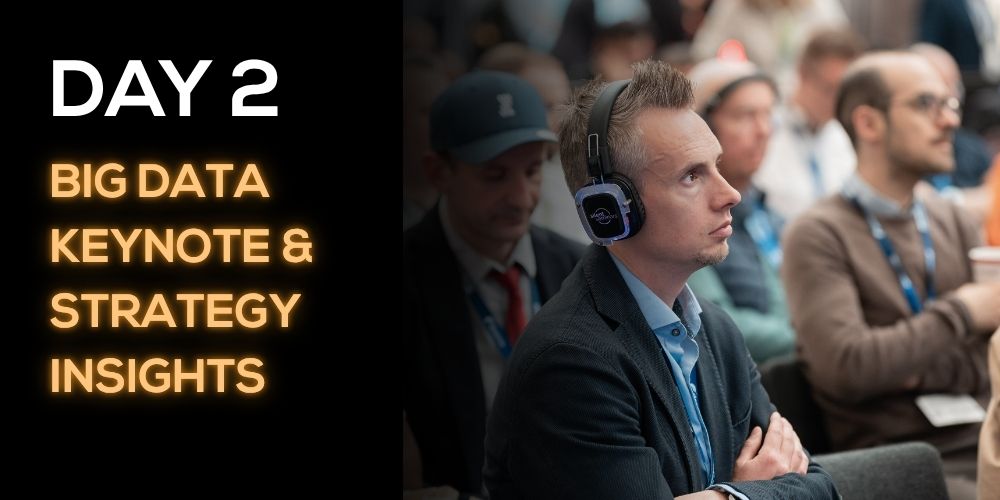
Day 2 of the Big Data Keynote & Strategy track at Tech Show Frankfurt did not move through topics so much as return repeatedly to the same condition, seen from different angles: organisations are no longer struggling to access AI, but to make it operate in ways that hold under real use.
The shift is subtle. The conversation is no longer about models, but about what surrounds them, ownership, workflows, data, behaviour, and how those elements align, or fail to, once systems leave controlled environments.
Where Ownership Sits
The tension becomes visible early in the discussion from Breuninger, where Iris Hollick and Dr Richa Sharma described how earlier AI initiatives often remained disconnected from the organisation itself, not because they failed technically, but because responsibility for outcomes remained unclear.
“If you have a lot of speed and you do not have ownership, that only means faster confusion.”
The increase in development speed does not resolve the problem. It amplifies it. Systems are delivered more quickly, but without clear ownership, the effect is not acceleration but fragmentation, where activity increases without coherence.
“Models don’t create value… owners do.”
The distinction shifts attention away from model performance and toward accountability, where value appears only once systems are anchored in decisions, processes and measurable outcomes.
“Model accuracy alone does not define the success of the project, but KPI does.”
From Data to Use
That same displacement appears in a different form in the discussion of data products, where Ales Zeman described how organisations continue to produce outputs without resolving how those outputs connect to use.
“What is the business case you have?”
The question appears before any architecture, and in its absence, work accumulates in other ways.
“350 Excel spreadsheets just to create one product.”
The repetition is not accidental. It reflects a system that produces artefacts without stabilising them, where each use case restarts the process rather than extending it.
“Start always with the business outcome.”
The alignment is not technical, but organisational, sitting between teams that produce data and those expected to use it.
When Production Begins
When the discussion moves into operational AI, the same pattern reappears, now at scale.
Michael Foy and Nhi Le described a shift from experimentation to production, but the transition remains incomplete.
“not just a trend… It’s a tipping point.”
The language suggests acceleration, but the underlying condition does not follow at the same pace.
“86 to 89% of agent pilots are actually failing.”
The failure is not positioned as a limitation of the technology itself, but as a disconnect, where systems exist without embedding into the processes they are meant to support.
“The pilot on its own does not create business value.”
The gap is not between idea and prototype, but between prototype and use.
Work Has to Change
That gap becomes more explicit when the discussion turns to adoption.
Dr Ofure Obazee approached the problem from the perspective of work itself, rather than tools.
“The problem here is… how the work itself has to be redesigned.”
The point lands differently in context. AI does not enter a neutral environment. It enters existing systems of work, where roles, expectations and incentives are already defined.
“We are not having those conversations enough.”
The misalignment sits between those defining the strategy and those carrying it out, where adoption depends less on access and more on whether those two layers meet.
Measurement follows the same uncertainty.
“don’t really tell you anything about the level of assurance or… trust.”
Activity becomes visible, but meaning does not necessarily follow. Trust appears not in usage, but at the moment where systems fail or behave in unexpected ways.
“Trust is always confirmed by what happens the very first time that the AI system gets it wrong.”
What Sits Beneath It
By the time the discussion returns to data management, the pattern is already familiar.
Florian Bigelmaier described a landscape where organisations continue to experiment, while value remains unevenly distributed.
“Our data is not ready.”
The statement appears less as a diagnosis and more as a condition that sits beneath multiple sessions, where systems depend on structures that have not yet stabilised.
“Experimenting” alongside “no substantial added value.”
The contradiction holds. Activity increases, but outcomes do not scale at the same rate.
Across the day, the constraint does not sit in access to AI, but in how systems are held together once they are introduced. Ownership, data, workflows and behaviour do not align automatically, and when they do not, speed exposes the gap rather than closing it.
What changes is not the capability itself, but the conditions required for it to operate, where execution depends on how many of those elements can be brought into alignment at once.
Written by Rebecca Uffindell Wed 13 May 2026
Tags:
AI Execution AI Governance Enterprise AI Tech Show Frankfurt 2026Most Viewed News
Fri 2 Oct 2026
AI skills gap grows despite 64% of workers using AI