
Cloud & AI Infrastructure London Day 2: Engineering AI for Operational Scale
Written by Rebecca Uffindell Fri 13 Mar 2026
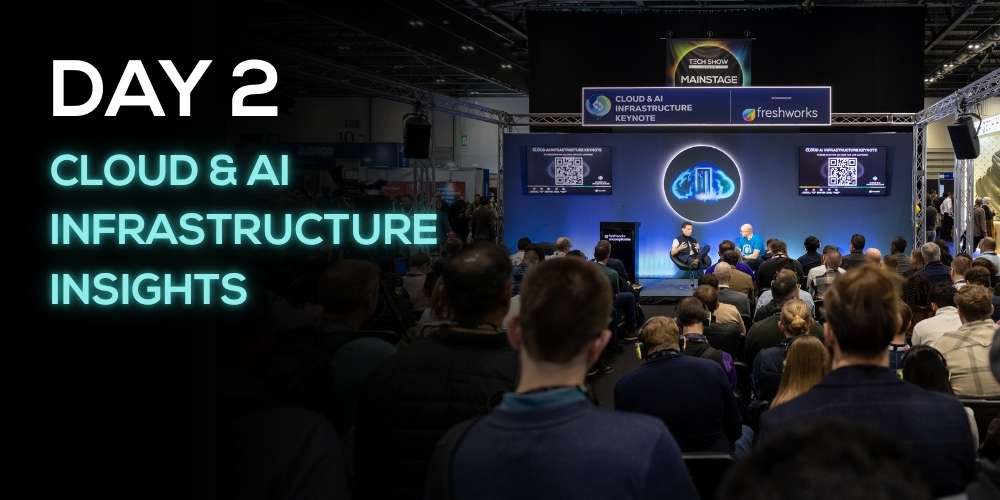
Day two of the Cloud & AI Infrastructure Keynote Theatre focused on what sustained AI deployment requires in practice. Where earlier discussions emphasised discipline and maturity, the second day concentrated on engineering systems capable of supporting AI in live, large-scale environments.
Across sessions spanning agentic AI, micro-edge cloud, hyperscale automation, architectural design drift and inference optimisation, a consistent pattern emerged. AI is increasingly embedded within infrastructure itself, and organisations leading adoption are those treating it as a systems engineering challenge rather than an experimental overlay.
Reimagining Organisations for the Agentic Era
A panel featuring Charles Ewen (Met Office) and Leigh Smith (Freshworks) examined how organisations must evolve to support AI at scale.
The panel moved beyond terminology debates around generative and agentic AI, instead focusing on enterprise readiness and structural transformation.
As one panellist observed:
“AI can be considered… yet another technology that is happening massively quickly. It’s very, very big. It’s very impactful.”
The discussion emphasised that scaling AI demands more than model deployment. It requires rethinking operating models, skills and governance structures.
“You really do need to be prepared to go back and reimagine your organisation.”
Investment in skills and mindset was highlighted as foundational.
“We’ve invested very heavily in skill sets and mindsets.”
The panel stressed that AI challenges existing business processes rather than simply optimising them.
“AI isn’t something that will mend existing business processes — it challenges what those business processes are.”
Governance was also reframed.
“Governance can be an enabler and not a blocker of Agentic AI adoption.”
Across perspectives, the discussion centred on organisational fluency — defining outcomes clearly, embedding enterprise-grade governance and aligning workforce capability with structural change.
Micro-Edge Cloud: Sovereignty Meets Latency
Chaired by Andy Bates and featuring Nicky Stewart (Open Cloud Coalition), Diar Abdlkarim (Motion Dynamics) and Dr Rois Ni Thuama, the micro-edge panel examined sovereignty, latency and board-level accountability.
Panellists reflected on market concentration in UK cloud services.
“70-90% of the UK cloud market is coalesced on just two cloud providers.”
The conversation emphasised strategic choice rather than default adoption.
“You do have a choice; you need to make the right choice now.”
Board-level governance surfaced repeatedly.
“There is an awareness gap at the highest level.”
“Management at the highest level now needs to take responsibility.”
Operational realities grounded the discussion.
“Latency with standard cloud providers… is not just an annoyance — it’s actually a failure.”
“We cannot afford any latency.”
The panel positioned micro-edge deployment as operationally critical in environments where sovereignty and real-time performance intersect.
Planet-Scale Fleet Management: Automation as Foundation
Igor Kanyuka of Meta examined the challenge of managing millions of bare-metal servers.
Referencing publicly available figures, he contextualised hyperscale operations.
“Amazon had about 1.4 million servers… Google operated 2.5 million servers.”
At that scale, manual operational models collapse. Provisioning, validation and lifecycle management must be industrialised.
“You need to provision them as fast as it’s possible, because you already paid money for them.”
Manual verification becomes unsustainable.
“People don’t want to do this. Don’t automate? Do automation.”
Kanyuka described the lifecycle complexity of hyperscale fleets: hardware validation at delivery, firmware updates at scale, component failure detection, rack-level dependency management and automated remediation.
He emphasised that dashboards alone are insufficient.
“Your dashboard will always be red.”
Reliability must be engineered into automation systems.
“Whatever you can do with automation, definitely do it.”
“Reliability is engineered.”
At hyperscale, automation is foundational to operational survival.
When Design Drift Shapes Traffic and Cost
Ellie Rahimi of Trainline presented a case study illustrating how architectural decisions evolve quietly over time.
Her team manages a search service handling 20 million daily requests.
“This is a search service… 20 million daily requests.”
Yet 99% of traffic was concentrated on just three endpoints, many of which were not true search use cases.
Rahimi identified domain ownership inconsistencies, reference lookups misaligned with architectural intent and endpoint misuse rooted in legacy assumptions. In one example, transaction ID lookups were routed through a search service unnecessarily.
“Does it sound like a search use case to you? Definitely not.”
By correcting these architectural misalignments, the team achieved a significant reduction in load.
“We were able to reduce 92% of that traffic.”
The lesson extended beyond query optimisation. Periodic architectural review prevents silent design drift from compounding into systemic inefficiency.
“These design drifts are silent.”
Unchecked over time, they inflate cost, distort traffic patterns and introduce avoidable operational risk.
Engineering for Operational Maturity
Across sessions, recurring themes surfaced: governance anchored at the board level, architectural discipline designed to prevent drift, automation-first operations capable of managing fleet-scale complexity, edge-aware deployment models sensitive to latency and sovereignty, and continuous review mechanisms that prevent silent inefficiencies.
AI capability continues to expand. The differentiator is how deliberately organisations engineer the systems that support it — power, networking, governance, automation and observability working in coordination.
Day two reflected a sector progressing from maturity toward sustained operational scale. Innovation remains important, but long-term advantage depends on disciplined engineering, infrastructure resilience and structured oversight.
The organisations shaping this phase are not defined by how quickly they deploy models, but by how reliably they build the systems that sustain them.

Written by Rebecca Uffindell Fri 13 Mar 2026
Tags:
AI Governance AI Operational Scale hyperscale infrastructure Infrastructure Automation Sovereign Cloud Tech Show London 2026Most Viewed News
Fri 2 Oct 2026
AI skills gap grows despite 64% of workers using AI